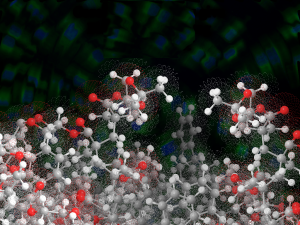
 Depending on their application it can be desirable for polymers to have strong adhesion to cell networks, for example a scaffold to promote regrowth and repair in a wound. Alternatively restricting protein adsorption can be an important role if drug delivery systems wish not to interact with the bodies natural immune system. We utilise a range of different methods to control cell and other biological adhesion.
Important Publications
-
- “Production and performance of biomaterials containing RGD-peptides” L. Perlin, S. MacNeil, S. Rimmer, Soft Matter, 4, 2331 (2008)
- “Cell adhesive hydrogels synthesized by copolymerization of arg-protected Gly-Arg-Gly-Asp-Ser methacrylate monomers and enzymatic deprotection” L. Perlin, S. MacNeil, S.Rimmer Chem Comm 5951 (2008)
- “Synthesis and properties of amphiphilic networks 3: Preparation and characterization of block conetworks of poly(butyl methacrylate-block-(2,3 propandiol-1-methacrylate-stat-ethandiol dimethacrylate))” S. Rimmer, M.J. German, J. Maughan, Y. Sun, N. Fullwood, J. Ebdon, S. MacNeil, Biomaterials, 26 2219 (2005)
- “Culture of dermal fibroblasts and protein adsorption on block conetworks of poly(butyl methacrylate-block-(2,3 propandiol-1-methacrylate-stat-ethandiol dimethacrylate))” Y. Sun , J. Collett , N.J. Fullwood , S. Mac Neil, S. Rimmer, Biomaterials 28 661 (2007)
- “Synthesis and properties of amphiphilic networks 2: A Differential scanning calorimetric study of poly(dodecyl methacrylate-stat-2,3 propandiol-1-methacrylate-stat-ethandiol dimethacrylate) networks and adhesion and spreading of dermal fibroblasts on these materials” R. Haigh, N. Fullwood, S. Rimmer, Biomaterials 23 3509 (2002)
- “Epithelialization of hydrogels achieved by amine surface modification and co-culture with stromal cells†S. Rimmer, C. Johnson, B. Zhao, J. Collier, L. Gilmore, S. Sabnis, P. Wyman, C. Sammon, N.J. Fullwood, S. MacNeil Biomaterials, 28 5319 (2007)
- “Cytocompatibility of poly(1,2 propandiol methacrylate) copolymer hydrogels and conetworks with or without alkyl amine functionality” S. Rimmer, Stacy-Paul Wilshaw, P. Pickavance, E. Ingham Biomaterials 30 2468 (2009)
- R. Plenderleith, C J Pateman, C Rodenburg, John Haycock, Frederik Claeyssens, Chris Sammon and Stephen Rimmer, Soft Matter, 2015 – Hydrogels were patterned with out highly branched polymer particles designed to adhere to fibroblast cells to support tissue regeneration and cell culturing.
- Kayleigh Cox-Nowak, Ohood Al-Yamani, Colin A. Grant, Nicola H. Green & Stephen Rimmer, International Journal of Polymeric Materials and Polymeric Biomaterials, 2017
- Andrew Mckenzie, Richard Hoskins, Thomas Swift , Colin Grant and Stephen Rimmer, Applied Materials & Interfaces, 2017 – Polystyrene particles shielded from protein adsorption by encasing them in a branched outer shell of glycerol monomethacrylate.