Highly branched poly(N-isopropyl acrylamide) functionalized with an inducer molecule suppresses quorum sensing in Chromobacterium violaceum

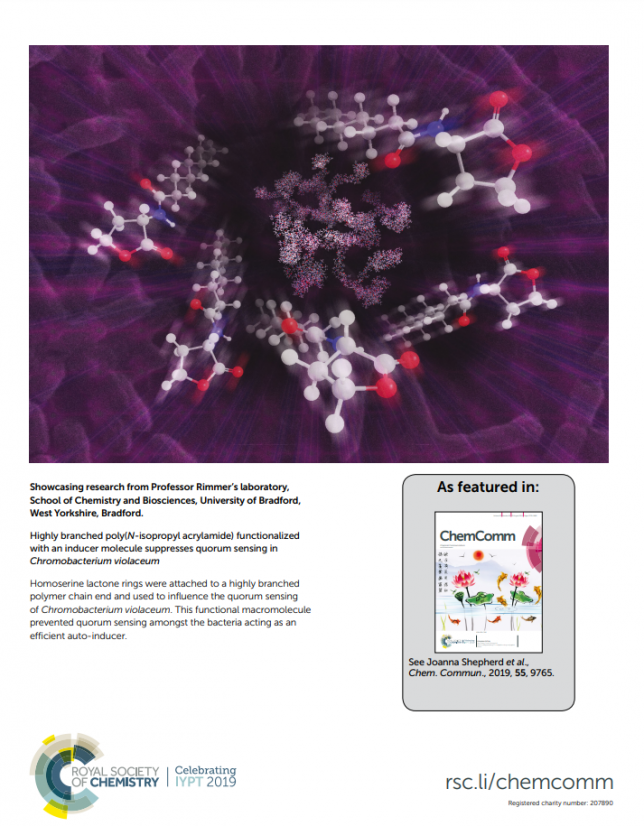
Highly branched poly(N-isopropyl acrylamide) functionalized with an inducer molecule suppresses quorum sensing in Chromobacterium violaceum

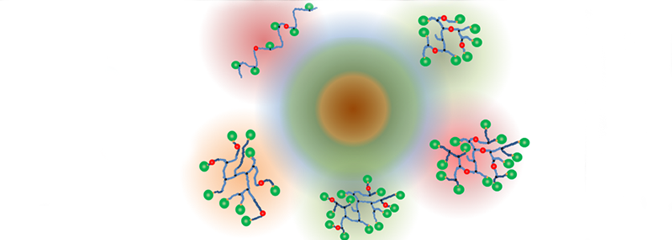
A new paper showcasing our collaborative work with Dr Shepherd in the University of Sheffield has just been published in ChemComm. This work, writing by Joey Shepherd, Tom Swift, Chien-Yi Chang, James R Boyne, Stephen Rimmer and William Martin showcases how HB-PNIPAM-HL can act as a quorum sensing antagonist and modulate how bacterial organisms communicate with one another.

Read more →
Highly-branched poly(N-isopropyl acrylamide) functionalised with pendant Nile red and chain end vancomycin for the detection of Gram-positive bacteria

Highly-branched poly(N-isopropyl acrylamide) functionalised with pendant Nile red and chain end vancomycin for the detection of Gram-positive bacteria

We are delighted to announce a new publication released today is our latest work in the area of bacterial diagnostics. We have attached Nile Red as a pendant dye to our highly branched PNIPAM polymers to create a diagnostic infection sensor, and our latest results are published in Acta Biomateriala.

Read more →

A muscle mimetic polyelectrolyte–nanoclay organic–inorganic hybrid hydrogel: its self-healing, shape-memory and actuation properties

A new paper has been published today in the Royal Society of Chemistry purchased Journal of Materials Chemistry B. This paper is the second following the visit from Sovan Banerjee from IIT Kharagpur to Bradford in 2016 and we are delighted that our collaboration with Prof Singha’s group is continuing to bear fruit.

Read the full paper at the J Mat Chem B website here.

Read more →
Highly-ordered onion micelles made from amphiphilic highly-branched copolymers

Highly-ordered onion micelles made from amphiphilic highly-branched copolymers

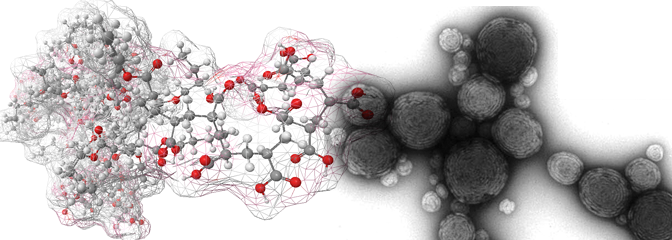
The Royal Society of Chemistry has just published our latest work; a collaboration between University of Bradford, University of Sheffield and Domino UK ltd. This paper, written by Dr Sarah Canning, with Professors Rimmer and Geoghen, shows the use of block poly butyl-methacrylate-co-acrylic acid to create uniform, onion forming micelles at the nanoscale.

Read more →

19th Recent Appointees in Polymer Science

The Polymer Biomaterials group is highly involved in hosting the 19th RAPS meeting at the University of Bradford, an event running from the 5th – 7th September 2018

Dr Beverly Stewart is providing a talk titled ‘Polymers and Theoretical Chemistry’ whilst RAPS committee member Dr Maria Katsikogianni is chairing a session. Dr Thomas Swift is also organising evening social activities after the dinner sessions.

We look forward to an exciting conference.

Dr Ryan Rees

Dr Ryan Rees

Dr Rees joined our group for 9 months in summer 2018 to bring his considerable industrial experience (Akzonobel, PPG) and assist us fulfilling commercial contracts.

He was responsible for upgrading our GPC systems and oversaw several laboratory renovations. He departed in March 2019 to pursue a career in the civil service.

Antibiotic functionalised polymers reduce bacterial biofilm and bioburden in a simulated infection of the cornea

Antibiotic functionalised polymers reduce bacterial biofilm and bioburden in a simulated infection of the cornea

Today online a new advanced access article is online at Biomaterials Science,  launched following our recent collaboration with the team at the University of Sheffield. This paper shows the efficacy of our recent highly branched polymer materials to disturb or prevent the formation of bacterial biofilms.

Read more →

Segmental Mobility Studies of Poly(N‐isopropyl acrylamide) Interactions with Gold Nanoparticles and Its Use as a Thermally Driven Trapping System

Segmental Mobility Studies of Poly(N‐isopropyl acrylamide) Interactions with Gold Nanoparticles and Its Use as a Thermally Driven Trapping System

Published online as early access today, a brand new communication has been published in Macromolecular Rapid Communications, by Dr Swift and collaborator Dr Hickey.  This article shows a first examination of the interaction between gold nanoparticles and linear PNIPAM polymer chains and can be read at the MRC website here.

Read more →

A self-healable fluorescence active hydrogel based on ionic block copolymers prepared via ring opening polymerization and xanthate mediated RAFT polymerization

We are delighted to publish the first of several collaborations with our colleagues in IIT Kharagpur has been accepted for publication with RSC journal Polymer Chemistry. This publication, outlining a self healing fluorescent hydrogel, is a functional demonstration of new material types we have been actively developing for several years. Read the article at the RSC Polymer chemistry website.

Read more →

Temperature-dependent structure and dynamics of highly-branched poly(N-isopropylacrylamide) in aqueous solution

Temperature-dependent structure and dynamics of highly-branched poly(N-isopropylacrylamide) in aqueous solution

Our colleagues in the Geoghegan group at the University of Sheffield have just published a detailed analysis of our highly branched polymer systems using neutron scattering, and neutron spin echo, techniques. This very interesting paper, written with the collaboration of Professor Rimmer, has just been published in Soft Matter.

Read more →