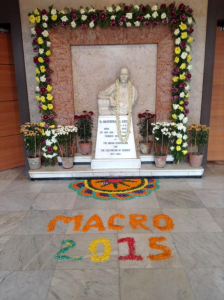
 The Rimmer group is proud to be presenting at the Indian Macro 2015 conference in Kolkata this year. Professor Stephen Rimmer is presenting an invited lecture entitled ‘Highly branched stimulus responsive polymers’ and Thomas Swift will be presenting an oral lecture ‘Polymers as Probes: Synthesis and Design of Polymer Probes for Fresh Water Applications’ in which he previews work currently under review with the RSC for imminent publication.
Author: Tom
RSC BIOMATERIALS CHEMISTRY SPECIAL INTEREST GROUP
In the new year the Rimmer group will be attending the RSC Biomaterials Special Interest Group [link here] which is being held this year at King’s College, London.
Regular attendees at this event we will be presenting a range of posters showing recent research from Sheffield University and there will be a 15 minute presentation by Thomas Swift entitled ‘Bacteria Binding by a Fluorescent Polymer Probe’ which ties together research presented in our latest highly branched polymer paper with previous bacteria binding systems published over the last five years.
Dr. Enas Hassan
Synthetic Hydrogels for Corneal Regeneration
An EPSRC funded Doctoral Training Center for Tissue Engineering and Regenerative Medice PhD supervised by Prof Stephen Rimmer, Prof Sheila Mac Neil [2010-2014]

Poly(acrylic acid) Interpolymer Complexation: Use of a Fluorescence Time Resolved Anisotropy as a Poly(acrylamide) Probe
Today we have heard another manuscript has just been accepted by RSC Advances, written by Dr. Thomas Swift, Dr. Linda Swanson and Professor Stephen Rimmer, titled “Poly(acrylic acid) Interpolymer Complexation: Use of a Fluorescence Time Resolved Anisotropy as a Poly(acrylamide) Probe.” The paper outlines novel use of time-resolved anisotropy as a sensing technique, determining ppm concentrations of poly(acrylamide) in aqueous solutions.
Dr. Laura Platt
The Development of an Improved Ion Transfer Material for Use in an Electrochemical Cell
Supervised by Professor Stephen Rimmer, Dr Patrick Fairclough (Department of Chemistry) and Dr Kris Hyde (ITM Power). E-Futures Doctoral Training Centre (EPSRC Funded) with Sponsorship from ITM Power [2010-2013]
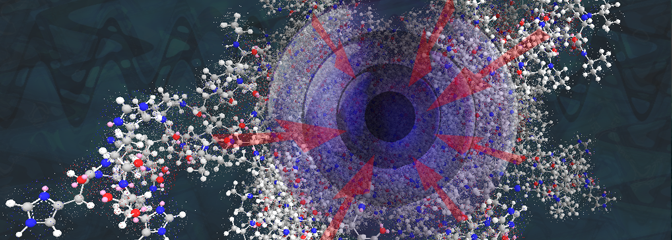
Highly-branched Poly(N-isopropyl acrylamide)s with core-shell morphology below the lower critical solution temperature
A new paper has just been accepted by RSC Advances, written by Richard Plenderleith, Dr. Thomas Swift and Dr. Stephen Rimmer, titled Highly-branched Poly(N-isopropyl acrylamide)s with core-shell morphology below the lower critical solution temperature.
Dominic Gray
1,1-diphenylethylene mediated Emulsion Polymerisation
Polymer, Soft Matter and Colloid DTC, PhD supervised by Prof Stephen Rimmer [2014-2018] with BASF
Kathryn Murray
Development of Hydrophilic Polyurethanes for use in Wound Dressings
Polymer, Soft Matter and Colloid DTC, PhD supervised by Prof Stephen Rimmer [2014-2018] with SCAPA Healthcare
Northern Universities Postgraduate Symposium
 The Biopolymer Laboratories are proud to announce we are today heavily involved in the organisation of the Northern Universities Postgraduate Symposium, an event due to be hosted in the University of Sheffield chemistry department with funding from the Royal Society of Chemistry Younger Member Network. Organised by current postgraduate students in the Chemistry department the symposium will celebrate a variety of chemical disciplines and demonstrate the range of current groundbreaking research taking place across the north of England.
The event is hosted by our own Doctor Thomas Swift, with both Sarah Canning and Simon Finnegan acting on the organizing committee. Whilst no biopolymer talks are scheduled we have a strong contingent of posters at the event which has attracted visitors from the Universities of Newcastle, Durham, York, Leeds, Manchester, Liverpool, Huddersfield, Sheffield, Sheffield Hallam, Nottingham and more.
The facebook page for the group, with photos from the event, can be found here:
Paper: Antiseptics for treating infected wounds: Efficacy on biofilms and effect of pH
Simon Finnegan and Stephen Rimmer have contributed to a review article published in Critical Reviews in Microbiology today. The paper entitled ‘Antiseptics for treating infected wounds: Efficacy on biofilms and effect of pH’ discusses the critical role biofilms have in wound infection post treatment.
ACS National Meeting Fall 2014; San Francisco

Professor Stephen Rimmer and Doctor Thomas Swift have both traveled to America to present at the American Chemical Society conference in San Francisco held this week.
Presentations
| 776 | Determining polymeric contamination in industrial recycled water Thomas Swift, Stephen Rimmer, Linda Swanson |
224 | Poly(N-isopropyl acrylamide) responsive to the presence of bacteria Stephen Rimmer, Pavintorn Teratanatorn, Joanna Shepherd, Sheila Macneil, Ian Douglas, Richard Hoskins |
Posters:
378 | Bacteria and fungal binding by a fluorescent polymer probe Thomas Swift, Stephen Rimmer, Richard Hoskins |
| 493 | Fluorescence labelled dynamic polymer probes: Examining solution behaviour and polymer-polymer interactions Thomas Swift, Stephen Rimmer, Linda Swanson |
Paper: Clinical and Antibiofilm Efficacy of Antimicrobial Hydrogels
A new paper has been accepted by the journal Advances in Woundcare, written by collaborator Stephen Percival, group member Simon Finnegan and Professor Stephen Rimmer.
UK Colloids – London 2014
The Rimmer Groups are proud to have presented both an oral talk and two posters at the UK Colloids 2014 meeting in London this weekend. The talk will be given by Sarah Canning and is entitled ‘Self-Assembly of Poly (Methacrylate-co-Acrylic Acid) Copolymers of Varying Architecture Synthesised by RAFT Polymerisation’ ‘ which will be accompanied by one poster by herself and another by Laura Shallcross.
More details about the event can be found UK Colloids Website
Farewell Melanie Hannah
This week we say farewell to Melanie Hannah who has ably supporting the Rimmer Group (and the rest of the Sheffield Chemistry Department) for the last few years, ensuring equipment is well managed and providing specific oversight over our GPC equipment.
She leaves to take up another position in the University and will be sorely missed.
Förster resonance energy transfer confirms the bacterial-induced conformational transition in highly-branched poly(N-isopropyl acrylamide with vancomycin end groups on binding to Staphylococcus aureus
Prodip Sarker, Kathryn Swindells, C. W. Ian Douglas, Sheila MacNeil, Stephen Rimmer and Linda Swanson have just released a paper in the RSC Journal Soft matter.