We are delighted to announce the release of a methods paper outlining the preparation and use of our triple modified PNIPAM gels for bacteria swabbing of infected surfaces.
Read more
We are delighted to announce the release of a methods paper outlining the preparation and use of our triple modified PNIPAM gels for bacteria swabbing of infected surfaces.
Read more
We are proud to announce the publication of work alongside our collaborators at L V Prasad Eye Institute and the University of Sheffield. This paper outlines our recent funded project from the Wellcome Trust to develop analytical devices to detect corneal infections, providing a rapid test for isolation of gram negative, gram positive or fungal pathogens.
Read more
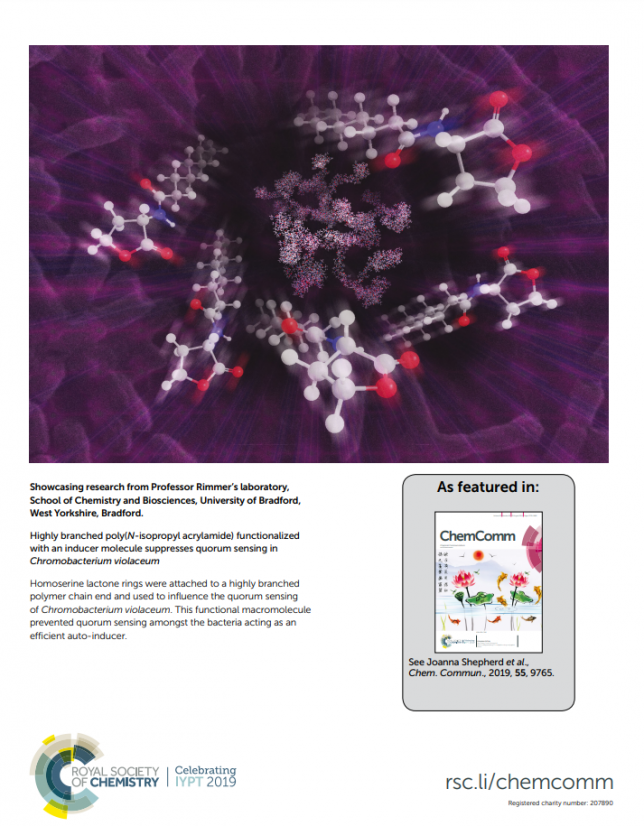
A new paper showcasing our collaborative work with Dr Shepherd in the University of Sheffield has just been published in ChemComm. This work, writing by Joey Shepherd, Tom Swift, Chien-Yi Chang, James R Boyne, Stephen Rimmer and William Martin showcases how HB-PNIPAM-HL can act as a quorum sensing antagonist and modulate how bacterial organisms communicate with one another.
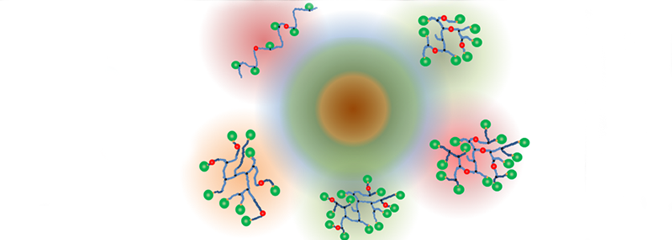
We are delighted to announce a new publication released today is our latest work in the area of bacterial diagnostics. We have attached Nile Red as a pendant dye to our highly branched PNIPAM polymers to create a diagnostic infection sensor, and our latest results are published in Acta Biomateriala.
Read moreToday online a new advanced access article is online at Biomaterials Science, launched following our recent collaboration with the team at the University of Sheffield. This paper shows the efficacy of our recent highly branched polymer materials to disturb or prevent the formation of bacterial biofilms.
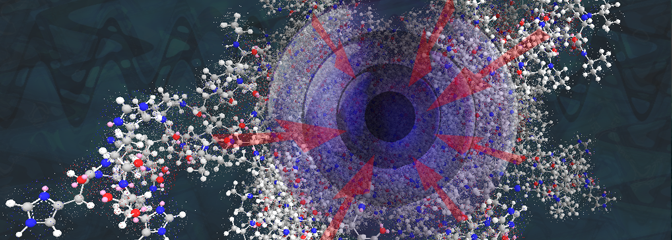
Our colleagues in the Geoghegan group at the University of Sheffield have just published a detailed analysis of our highly branched polymer systems using neutron scattering, and neutron spin echo, techniques. This very interesting paper, written with the collaboration of Professor Rimmer, has just been published in Soft Matter.
ACS Biomacromolecules has just announced the upcoming publication of our latest piece of research, a collaboration between Thomas Swift, Stephen Rimmer and Richard Hoskins from University of Bradford and Joey Shepherd, Pavintorn Teratanatorn, Ian Douglas and Sheila MacNeil from the University of Sheffield. This paper, available now from the Biomacromolecules website, shows our latest work in disclosing bacteria/polymer binding and further development towards a colorimetric sensor.

We’re delighted to confirm our latest publication with RSC Advances is now available online. This paper, published by Thomas Swift, James Lapworth, Kathryn Swindells, Linda Swanson and Stephen Rimmer concerns using two fluorescence labels to track the swelling / collapse of a highly branched polymer with changing charge density at the chain ends.
A new paper has just been accepted by RSC Advances, written by Richard Plenderleith, Dr. Thomas Swift and Dr. Stephen Rimmer, titled Highly-branched Poly(N-isopropyl acrylamide)s with core-shell morphology below the lower critical solution temperature.
Prodip Sarker, Kathryn Swindells, C. W. Ian Douglas, Sheila MacNeil, Stephen Rimmer and Linda Swanson have just released a paper in the RSC Journal Soft matter.
Prodip Sarker, Joanna Shepherd, Kathryn Swindells, Ian Douglas, Sheila MacNeil, Linda Swanson and Stephen Rimmer have published a paper in the journal Bio-Macromolecules.
Joanna Shepherd, Prodip Sarker, Stephen Rimmer, Linda Swanson, Sheila MacNeil and Ian Douglas have just published a paper in the journal Biomaterials.
A new communication by Joanna Shepherd, Prodip Sarker, Kathryn Swindells, Ian Douglas, Sheila MacNeil, Linda Swanson and Stephen Rimmer has just been published in the Journal of the American Chemical Society.
Steven Carter, Stephen Rimmer, Ramune Rutkaite, Linda Swanson, Patrick Fairclough, Alice Sturdy and Michelle Webb have published an article in the journal Bio-Macromolecules.
A paper has been published in macromolecules bioscience which demonstrates the use of highly branched poly(N-isopropylacrlyamide) polymers for protein purification prcesses dependent on the LCST of the polymer.