Overcoming ‘Diffusion Limits’ – Principles Required to Measure High Molar Mass Polymers by Diffusion Ordered NMR

Overcoming ‘Diffusion Limits’ – Principles Required to Measure High Molar Mass Polymers by Diffusion Ordered NMR

We are delighted that our group has published another scientific article describing the complexity of analysing high molar mass polymers via DOSY NMR. This work has been accepted by the prestigious journal Analytica Chimica Acta and can be found online at their website where it is open access (free to read to anyone without paying subscription access).

Read more →

Photophysical, thermal and imaging studies on vancomycin functional branched poly(N-isopropyl acrylamide) of differing degrees of branching containing nile red for detection of Gram-positive bacteria

We are delighted to announce important new work on our bacteria binding system has been published on the Royal Society of Chemistry’s Journal of Materials Chemistry B – part of their special collection on the Targeted Biomedical Application of Nanomaterials. This work by Thomas Swift, Steve Rimmer and Maria Katsikogianni shows an evolution of our understanding of the polymer desolating materials that underpin our rapid diagnostic technology. The article is open access and free to read for anyone on the RSC website.

Read more →
Chain-Extendable Crosslinked Hydrogels Using Branching RAFT Modification

Chain-Extendable Crosslinked Hydrogels Using Branching RAFT Modification

We are delighted to announce publication of new work incorporating our branching chain transfer agent into crosslinked hydrogels, to produce novel functional materials. The full manuscript is available open access on MDPI Gels.

Abstract:

Functional crosslinked hydrogels were prepared from 2-hydroxyethyl methacrylate (HEMA) and acrylic acid (AA). The acid monomer was incorporated both via copolymerization and chain extension of a branching, reversible addition–fragmentation chain-transfer agent incorporated into the crosslinked polymer gel. The hydrogels were intolerant to high levels of acidic copolymerization as the acrylic acid weakened the ethylene glycol dimethacrylate (EGDMA) crosslinked network. Hydrogels made from HEMA, EGDMA and a branching RAFT agent provide the network with loose-chain end functionality that can be retained for subsequent chain extension. Traditional methods of surface functionalization have the downside of potentially creating a high volume of homopolymerization in the solution. Branching RAFT comonomers act as versatile anchor sites by which additional polymerization chain extension reactions can be carried out. Acrylic acid grafted onto HEMA–EGDMA hydrogels showed higher mechanical strength than the equivalent statistical copolymer networks and was shown to have functionality as an electrostatic binder of cationic flocculants.

Evaluation of ligand modified poly (N-Isopropyl acrylamide) hydrogel for etiological diagnosis of corneal infection

Evaluation of ligand modified poly (N-Isopropyl acrylamide) hydrogel for etiological diagnosis of corneal infection

We are proud to announce the publication of work alongside our collaborators at L V Prasad Eye Institute and the University of Sheffield. This paper outlines our recent funded project from the Wellcome Trust to develop analytical devices to detect corneal infections, providing a rapid test for isolation of gram negative, gram positive or fungal pathogens.

Read more →
Synthesis of poly(vinyl ether)s by chain-end capping with a silyl ketene acetal in ab initio cationic polymerisations

Synthesis of poly(vinyl ether)s by chain-end capping with a silyl ketene acetal in ab initio cationic polymerisations

Professor Rimmer has just had a new paper accepted in Arkivoc, a platinum open access journal for organic chemistry, published as a special invited paper celebrating the career of Philip Hodge. This paper examined the modification to introduce silyl ketone acetals in poly(vinyl ethers). The paper can be accessed via the arkat-usa website here.

Read more →
Semi-interpenetrating Polyurethane Network Foams Containing Highly Branched Poly(N-isopropyl acrylamide) with Vancomycin Functionality

Semi-interpenetrating Polyurethane Network Foams Containing Highly Branched Poly(N-isopropyl acrylamide) with Vancomycin Functionality

A new paper has been published on incorporation of our bacteria sensing polymers in a polyurethane wound dressing. This work has ben published by ACS Applied Biomaterials and can be read online at their website.

Read more →
Label-Free Electrochemical Sensor for Rapid Bacterial Pathogen Detection Using Vancomycin-Modified Highly Branched Polymers

Label-Free Electrochemical Sensor for Rapid Bacterial Pathogen Detection Using Vancomycin-Modified Highly Branched Polymers

A new publication has been released by our collaborators at the University of Edinburh and IIT Delhi. This paper outlines an electrochemical sensor for pathogen detection using our highly branched polymers and is available to read for free (open access) at MDPI here!

Read more →
Branched amphotericin functional poly(N-isopropyl acrylamide): an antifungal polymer

Branched amphotericin functional poly(N-isopropyl acrylamide): an antifungal polymer

A new paper is published and available online today – our latest work developing microbial infectious diseases has been targeted towards fungal systems. The entire paper is available to read here at The Royal Society.

Read more →
Project: Cayman

Project: Cayman

Professor Stephen Rimmer and Dr Thomas Swift are heavily involved in the recently funded Project Cayman, (Chemistry Assets for Yorkshire Manufacturing), a 3 year £1.6 million programme run by the University of Bradford thanks to funding from the Northern Powerhouse and European Union Regional Development Fund.

For more information visit the Project Cayman website or contact us for details about how our expertise in materials characterisation can benefit any projects you are working on.

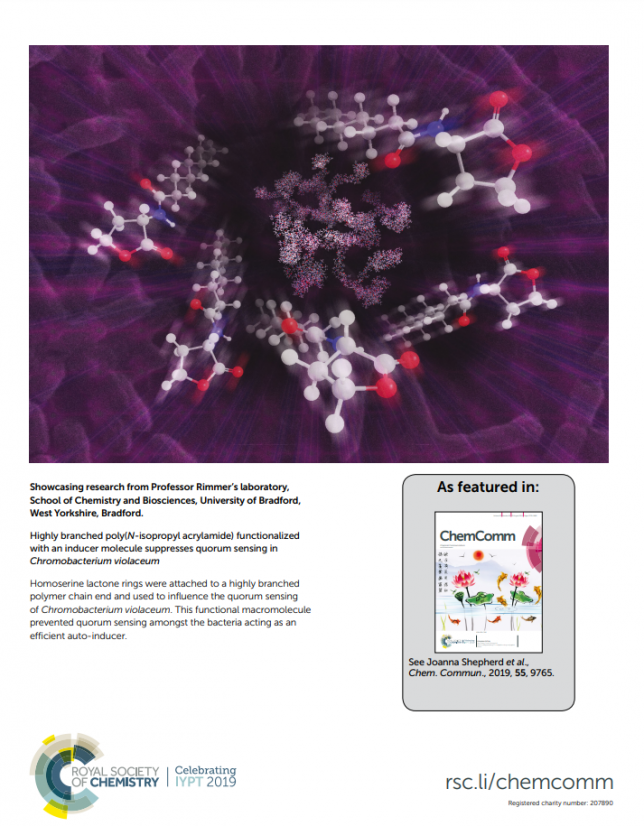
Highly branched poly(N-isopropyl acrylamide) functionalized with an inducer molecule suppresses quorum sensing in Chromobacterium violaceum

Highly branched poly(N-isopropyl acrylamide) functionalized with an inducer molecule suppresses quorum sensing in Chromobacterium violaceum

A new paper showcasing our collaborative work with Dr Shepherd in the University of Sheffield has just been published in ChemComm. This work, writing by Joey Shepherd, Tom Swift, Chien-Yi Chang, James R Boyne, Stephen Rimmer and William Martin showcases how HB-PNIPAM-HL can act as a quorum sensing antagonist and modulate how bacterial organisms communicate with one another.

Read more →
Sehaj Singh

Sehaj Singh

PhD Candidate

Sehaj Singh received a degree as a master of Natural Sciences (MNatSc) from the University of Leeds. Within this course, he has studied elements from Chemistry, Physics and Maths courses.
Since completing his MNatSc, he has undertaken a PhD at the University of Bradford and is currently developing antimicrobial polyurethane acrylates to be used for diagnostic and treatment applications in microbial keratitis. He is gaining experience in various forms of analysis including GPC, HPLC, GC, DOSY NMR and fluorescence methods as well as the use of SEM, TEM and LSCM. He is also working in a microbiological setting to test the effects of smart polymers on various bacteria strains.

Publications: