Highly-branched poly(N-isopropyl acrylamide) functionalised with pendant Nile red and chain end vancomycin for the detection of Gram-positive bacteria

Highly-branched poly(N-isopropyl acrylamide) functionalised with pendant Nile red and chain end vancomycin for the detection of Gram-positive bacteria

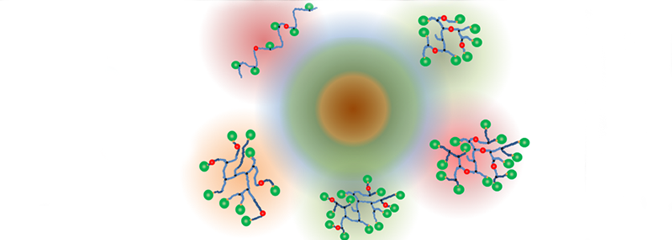
We are delighted to announce a new publication released today is our latest work in the area of bacterial diagnostics. We have attached Nile Red as a pendant dye to our highly branched PNIPAM polymers to create a diagnostic infection sensor, and our latest results are published in Acta Biomateriala.

Read more →
A muscle mimetic polyelectrolyte–nanoclay organic–inorganic hybrid hydrogel: its self-healing, shape-memory and actuation properties

A new paper has been published today in the Royal Society of Chemistry purchased Journal of Materials Chemistry B. This paper is the second following the visit from Sovan Banerjee from IIT Kharagpur to Bradford in 2016 and we are delighted that our collaboration with Prof Singha’s group is continuing to bear fruit.

Read the full paper at the J Mat Chem B website here.

Read more →
Highly-ordered onion micelles made from amphiphilic highly-branched copolymers

Highly-ordered onion micelles made from amphiphilic highly-branched copolymers

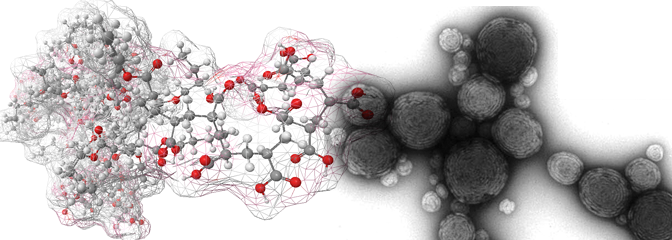
The Royal Society of Chemistry has just published our latest work; a collaboration between University of Bradford, University of Sheffield and Domino UK ltd. This paper, written by Dr Sarah Canning, with Professors Rimmer and Geoghen, shows the use of block poly butyl-methacrylate-co-acrylic acid to create uniform, onion forming micelles at the nanoscale.

Read more →
Antibiotic functionalised polymers reduce bacterial biofilm and bioburden in a simulated infection of the cornea

Antibiotic functionalised polymers reduce bacterial biofilm and bioburden in a simulated infection of the cornea

Today online a new advanced access article is online at Biomaterials Science,  launched following our recent collaboration with the team at the University of Sheffield. This paper shows the efficacy of our recent highly branched polymer materials to disturb or prevent the formation of bacterial biofilms.

Read more →

A self-healable fluorescence active hydrogel based on ionic block copolymers prepared via ring opening polymerization and xanthate mediated RAFT polymerization

We are delighted to publish the first of several collaborations with our colleagues in IIT Kharagpur has been accepted for publication with RSC journal Polymer Chemistry. This publication, outlining a self healing fluorescent hydrogel, is a functional demonstration of new material types we have been actively developing for several years. Read the article at the RSC Polymer chemistry website.

Read more →

Temperature-dependent structure and dynamics of highly-branched poly(N-isopropylacrylamide) in aqueous solution

Temperature-dependent structure and dynamics of highly-branched poly(N-isopropylacrylamide) in aqueous solution

Our colleagues in the Geoghegan group at the University of Sheffield have just published a detailed analysis of our highly branched polymer systems using neutron scattering, and neutron spin echo, techniques. This very interesting paper, written with the collaboration of Professor Rimmer, has just been published in Soft Matter.

Read more →

Poly(acrylic acid) Interpolymer Complexes

Poly(acrylic acid) Interpolymer Complexes

Today we were delighted to hear from RSC Soft Matter that they are publishing one of our articles on “Polyacrylic acid interpolymer Complexation”. This paper is written by Drs Thomas Swift, Colin Seaton and Stephen Rimmer, and can be found at the Soft Matter website. This is the latest in a series of articles studying interpolymer complexation carried out by the group in recent years.

Read more →

Binding of bacteria to poly (N-isopropylacrylamide) modified with vancomycin: Comparison of behavior of linear and highly branched polymers

Binding of bacteria to poly (N-isopropylacrylamide) modified with vancomycin: Comparison of behavior of linear and highly branched polymers

ACS Biomacromolecules has just announced the upcoming publication of our latest piece of research, a collaboration between Thomas Swift, Stephen Rimmer and Richard Hoskins from University of Bradford and Joey Shepherd, Pavintorn Teratanatorn, Ian Douglas and Sheila MacNeil from the University of Sheffield. This paper, available now from the Biomacromolecules website, shows our latest work in disclosing bacteria/polymer binding and further development towards a colorimetric sensor.

Read more →

Event – Polymer Process Engineering 17

Doctor Thomas Swift, Maria Katsikogianni and Professor Rimmer are all presenting at the Polymer IRC this July.
Professor Rimmer will deliver a keynote speech on Highly branched poly(N-isopropyl acrylamide) for tackling antimicrobial resistance whilst Doctors Swift and Katsikogianni will be giving short oral presentations on harnessing nano-patterning and incorporation of antimicrobials to manufacture orthopaedic trauma implants and Polymer Characterisation.

Find out more about this conference here.

The effect of hyperbranched poly(acrylic acid)s on the morphology and size of precipitated nanoscale (fluor)hydroxyapatite

The effect of hyperbranched poly(acrylic acid)s on the morphology and size of precipitated nanoscale (fluor)hydroxyapatite

We’ve just received news from our collaborator Sebastian Spain, from the University of Sheffield, that a paper written by group alumni Laura Shallcross, detailing work that started when she was with us, has been published by the Royal Society of Chemistry, Journal of Materials Chemistry B. The full text can be found at the RSC website.

Read more →

Förster Resonance Energy Transfer across interpolymer complexes of poly(acrylic acid) and poly(acrylamide)

Förster Resonance Energy Transfer across interpolymer complexes of poly(acrylic acid) and poly(acrylamide)

We have just published brand new research into interpolymer complexation, work carried out by Thomas Swift, Stephen Rimmer, Maria Katsikogianni, Natalie Paul and Linda Swanson. This work can now be found online at Science Direct.

Read more →

Analysis Using Size Exclusion Chromatography of poly(N-isopropyl acrylamide) using Methanol as an Eluent

Analysis Using Size Exclusion Chromatography of poly(N-isopropyl acrylamide) using Methanol as an Eluent

An advanced proof of our latest work has just gone live at Science Direct where it can be read in advance of final corrections. This work, carried out by Thomas Swift, Richard Hoskins, Richard Telford, David Pownell, Richard Plenderleith and Stephen Rimmer outlines a dual approach to preparing brand new chromatography techniques for characterising polymers.

Read more →

Poly(n-butyl Methacrylate) with Primary Amine End Groups for Supporting Cell Adhesion and Proliferation of Renal Epithelial Cells

A brand new piece of research has just been accepted for publication in the Taylor and Francis published ‘International Journal of Polymeric Materials and Polymeric Biomaterials’. This work, titled ‘Poly(n-butyl Methacrylate) with Primary Amine End Groups for Supporting Cell Adhesion and Proliferation of Renal Epithelial Cells’ can be found here.

Read more →

Ex vivo rabbit and human corneas as models for bacterial and fungal keratitis

Our collaborators in Sheffield have published a paper on using rabbit and human corneas as models for bacterial colonisation. This is very important, relevant work developed on a project in collaboration with the polymer biomaterials group and we will be using in future work. The paper is written by Abigail Pinnock, with Stephen Rimmer, Ian Douglas and Sheila MacNeil as co-authors.

The full paper can be found here.

Read more →