Developments in silicone technology for use in stoma care

Developments in silicone technology for use in stoma care

We have just written an article for the British Journal of Nursing commenting on developments of the use of silicone polymer technology in stoma care. This article, written by Thomas Swift, Gillian Westgate, Julie Van Onselen and Stewart Lee reports on the background theory behind the development of a new silicone product due to launch later this year that we hope to report on soon.

Read more →
AmNS Tagged Polymers

Fluorescence Spectroscopy Analysis of the Bacteria–Mineral Interface: Adsorption of Lipopolysaccharides to Silica and Alumina

We’re delighted that we have just published an article in the journal Langmuir. This study, written by Fateh El-Taboni, Emily Caseley, Maria Katsikogianni, Linda Swanson, Thomas Swift and Maria E. Romero-González reports our work on studying Liposaccharide’s produced by bacteria in the formation of biofilms. The full paper can be read at the journal Langmuir

Read more →
Osteoinduction of 3D printed particulate and short-fibre reinforced composites produced using PLLA and Apatite-Wollastonite

Osteoinduction of 3D printed particulate and short-fibre reinforced composites produced using PLLA and Apatite-Wollastonite

Today a paper from our collaborators at the University of Newcastle has just been released for viewing in the journal Composite Science and Materials. This is written by Priscila Melo from the Dalgarno research group, and features the contributions of Dr Thomas Swift to characterise the materials.

Read more →
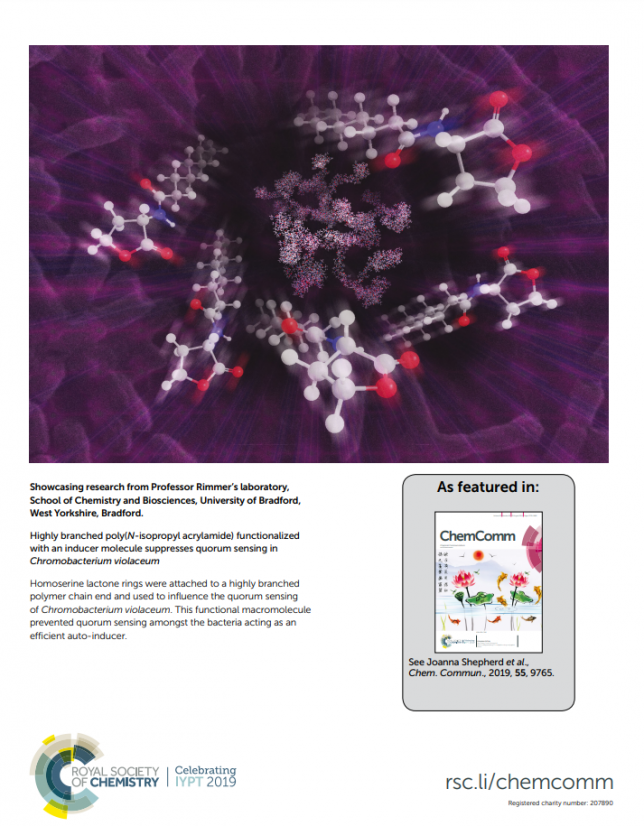
Highly branched poly(N-isopropyl acrylamide) functionalized with an inducer molecule suppresses quorum sensing in Chromobacterium violaceum

Highly branched poly(N-isopropyl acrylamide) functionalized with an inducer molecule suppresses quorum sensing in Chromobacterium violaceum

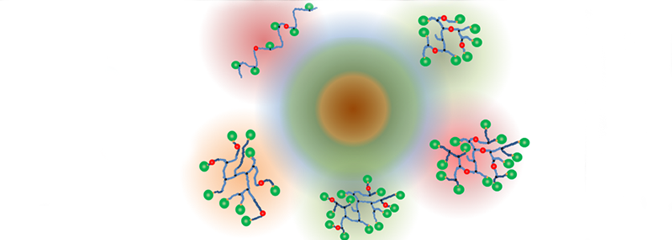
A new paper showcasing our collaborative work with Dr Shepherd in the University of Sheffield has just been published in ChemComm. This work, writing by Joey Shepherd, Tom Swift, Chien-Yi Chang, James R Boyne, Stephen Rimmer and William Martin showcases how HB-PNIPAM-HL can act as a quorum sensing antagonist and modulate how bacterial organisms communicate with one another.

Read more →
Sehaj Singh

Sehaj Singh

PhD Candidate

Sehaj Singh received a degree as a master of Natural Sciences (MNatSc) from the University of Leeds. Within this course, he has studied elements from Chemistry, Physics and Maths courses.
Since completing his MNatSc, he has undertaken a PhD at the University of Bradford and is currently developing antimicrobial polyurethane acrylates to be used for diagnostic and treatment applications in microbial keratitis. He is gaining experience in various forms of analysis including GPC, HPLC, GC, DOSY NMR and fluorescence methods as well as the use of SEM, TEM and LSCM. He is also working in a microbiological setting to test the effects of smart polymers on various bacteria strains.

Publications:

Highly-branched poly(N-isopropyl acrylamide) functionalised with pendant Nile red and chain end vancomycin for the detection of Gram-positive bacteria

Highly-branched poly(N-isopropyl acrylamide) functionalised with pendant Nile red and chain end vancomycin for the detection of Gram-positive bacteria

We are delighted to announce a new publication released today is our latest work in the area of bacterial diagnostics. We have attached Nile Red as a pendant dye to our highly branched PNIPAM polymers to create a diagnostic infection sensor, and our latest results are published in Acta Biomateriala.

Read more →

A muscle mimetic polyelectrolyte–nanoclay organic–inorganic hybrid hydrogel: its self-healing, shape-memory and actuation properties

A new paper has been published today in the Royal Society of Chemistry purchased Journal of Materials Chemistry B. This paper is the second following the visit from Sovan Banerjee from IIT Kharagpur to Bradford in 2016 and we are delighted that our collaboration with Prof Singha’s group is continuing to bear fruit.

Read the full paper at the J Mat Chem B website here.

Read more →
Highly-ordered onion micelles made from amphiphilic highly-branched copolymers

Highly-ordered onion micelles made from amphiphilic highly-branched copolymers

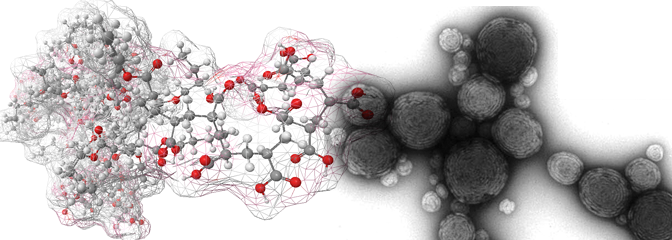
The Royal Society of Chemistry has just published our latest work; a collaboration between University of Bradford, University of Sheffield and Domino UK ltd. This paper, written by Dr Sarah Canning, with Professors Rimmer and Geoghen, shows the use of block poly butyl-methacrylate-co-acrylic acid to create uniform, onion forming micelles at the nanoscale.

Read more →

19th Recent Appointees in Polymer Science

The Polymer Biomaterials group is highly involved in hosting the 19th RAPS meeting at the University of Bradford, an event running from the 5th – 7th September 2018

Dr Beverly Stewart is providing a talk titled ‘Polymers and Theoretical Chemistry’ whilst RAPS committee member Dr Maria Katsikogianni is chairing a session. Dr Thomas Swift is also organising evening social activities after the dinner sessions.

We look forward to an exciting conference.

Dr Ryan Rees

Dr Ryan Rees

Dr Rees joined our group for 9 months in summer 2018 to bring his considerable industrial experience (Akzonobel, PPG) and assist us fulfilling commercial contracts.

He was responsible for upgrading our GPC systems and oversaw several laboratory renovations. He departed in March 2019 to pursue a career in the civil service.